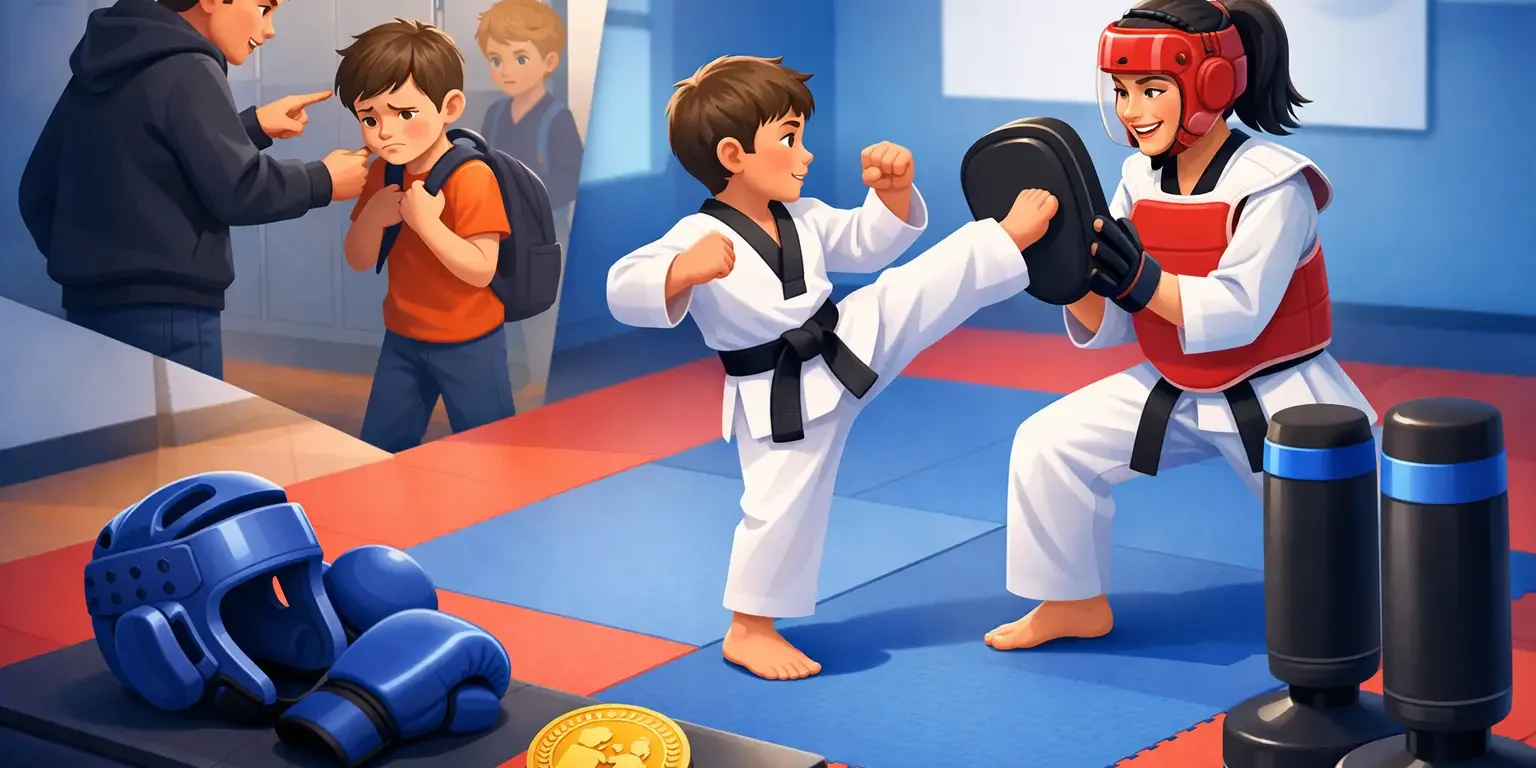
A child who feels targeted at school may not need to become tougher in the way adults sometimes imagine. They need to stand a little taller, speak clearly, recognize when to get help, and know they are not alone. Bullying prevention through taekwondo supports those skills by giving children a structured place to practice confidence, respect, self-control, and safe responses to difficult situations.
For families in Kalamazoo and nearby communities, that matters because bullying rarely has one simple solution. A confident response can help in some situations. In others, the right answer is to walk away, involve a teacher, document what happened, or ask a parent for help. Quality martial arts training prepares students to make those distinctions rather than treating every conflict like a fight.
Why Taekwondo Can Support Bullying Prevention
Taekwondo is often recognized for kicks, forms, and belts, but the most valuable lessons for a child dealing with peer conflict are usually practiced before any technique is taught. Students line up, listen, take turns, follow directions, and learn how to treat training partners with care. Those routines create a different experience from the uncertainty a child may feel in a hallway, on a bus, or at recess.
As students progress, they see proof that effort changes what they can do. A new student may arrive quietly, avoid eye contact, or hesitate to speak above a whisper. Over time, they learn a form, earn a stripe, help a newer student, or perform in front of their class. That progress is earned, not handed out, and it can give a child a more believable sense of confidence.
Confident body language can change social interactions. It is not a guarantee that a bully will stop, and children should never be blamed when bullying happens. Still, standing upright, looking ahead, using a firm voice, and leaving a situation calmly can make a child less likely to appear isolated or easily intimidated.
Confidence Without Aggression
One of the most useful lessons in martial arts is that strength and aggression are not the same thing. Students learn that their skills come with responsibility. The goal is not to win an argument, embarrass another child, or prove who is strongest. The goal is to stay safe and make good decisions under pressure.
In a positive taekwondo school, instructors correct unsafe behavior immediately. Students are expected to control their movements, respect personal space, and use their training only when necessary for self-protection. That consistent message helps children understand that walking away is not weakness. Often, it takes more self-control to leave a conflict than to react.
This distinction is especially helpful for children who feel angry, frustrated, or embarrassed after being picked on. Martial arts gives them a healthy outlet for big feelings while teaching them that physical skills are not a first response to verbal teasing or social conflict.
The Skills Children Practice in Class
Bullying can be physical, verbal, social, or digital. No martial arts class can solve every form of it, particularly behavior that happens online or outside adult supervision. What training can do is reinforce practical habits that help children respond with greater awareness and composure.
A student learns to listen closely to instructions and notice what is happening around them. They practice speaking loudly enough to be heard during drills and responding appropriately when an instructor gives a command. They learn boundaries through partner work: ask before making contact, use controlled movements, and stop when someone says stop. These are simple lessons, but they carry into everyday life.
Taekwondo also teaches students to reset after mistakes. Missing a move in a form, losing balance, or struggling with a new drill is normal. Students learn to breathe, try again, and accept coaching. That resilience can be valuable when a child has a difficult day at school and needs to keep asking for support rather than withdrawing.
Using a Clear, Safe Response
Parents can reinforce the same approach at home by practicing a few simple responses with their child. A calm, firm statement such as, “Stop. I don’t like that,” can be more effective than shouting back. The child should then create distance and seek a trusted adult when the behavior continues, becomes threatening, or involves physical contact.
The exact response depends on the situation. A child may be able to ignore a single rude comment and move toward friends. Repeated name-calling, exclusion, threats, unwanted touching, or harassment online should be reported. Parents should encourage children to share details, including who was involved, where it happened, and whether anyone saw it.
Martial arts instructors can reinforce these boundaries, but they are not a replacement for school staff, parents, counselors, or other professionals. When bullying is ongoing, adults need to work together on a clear safety plan. A child should never be expected to manage serious bullying alone.
What Parents Should Look for in a Martial Arts School
Not every martial arts environment teaches the same values. For bullying prevention to be a meaningful benefit, parents should look beyond a school’s physical curriculum. The atmosphere matters just as much as the techniques.
A strong program has clear rules, age-appropriate classes, and instructors who know how to lead with both encouragement and accountability. Younger children need active, engaging instruction that builds listening skills and confidence. Older kids and teens need room to develop leadership, discipline, and practical self-defense awareness without being pressured to act tough.
Parents should also notice how instructors address mistakes and conflict between students. Are children corrected respectfully? Do instructors make sure partners are safe? Is progress connected to effort, responsibility, and character as well as physical ability? Those details show whether the school is creating a culture children can carry into other parts of their lives.
At ATA Integrity Martial Arts, students train in a structured, supportive environment where respect, self-discipline, and non-violent conflict resolution are part of the journey. Age-based programs help each student learn at an appropriate pace while working toward meaningful goals.
Building a Support Team Around Your Child
The best results come when martial arts lessons are reinforced by the adults in a child’s life. Ask your child about class, not only about what kick they learned, but also about how they handled a challenge, showed respect, or helped a teammate. Celebrate effort and good judgment as much as belt progress.
It also helps to keep communication open with teachers and school leaders. If your child says something is happening repeatedly, listen without rushing to minimize it or immediately demand that they fight back. Thank them for telling you. Then gather facts, contact the appropriate adults, and help your child understand what will happen next.
Children are more likely to speak up when they believe adults will take them seriously. A steady response at home, combined with the confidence and discipline practiced in class, can help them feel supported rather than powerless.
A Stronger Definition of Self-Defense
Self-defense is more than a physical skill. For children, it begins with awareness, boundaries, communication, and the confidence to get help. Physical techniques have a place when someone faces immediate danger and cannot safely leave, but they should remain a last resort.
That is why taekwondo can be such a valuable part of a child’s development. Students are not simply learning how to kick. They are learning how to carry themselves with respect, stay composed when emotions run high, and trust their ability to make a smart next choice.
A child may not be able to control another person’s behavior, but they can build a stronger voice, a steadier posture, and a reliable circle of support. Those are lessons worth practicing well beyond the mat.