A child may see a high kick in one class and a strong hand technique in another, then announce a favorite before the first lesson even begins. For parents, the decision behind karate vs taekwondo for children is usually bigger than choosing the coolest move. You are looking for an activity that helps your child listen, build confidence, stay active, and learn how to handle challenges with respect.
Both arts can offer those benefits. The better fit depends on your child’s age, personality, goals, and, just as importantly, the quality of the school leading the class. A positive instructor and a structured program can make a lasting difference no matter which martial art your child studies.
What Is the Difference Between Karate and Taekwondo?
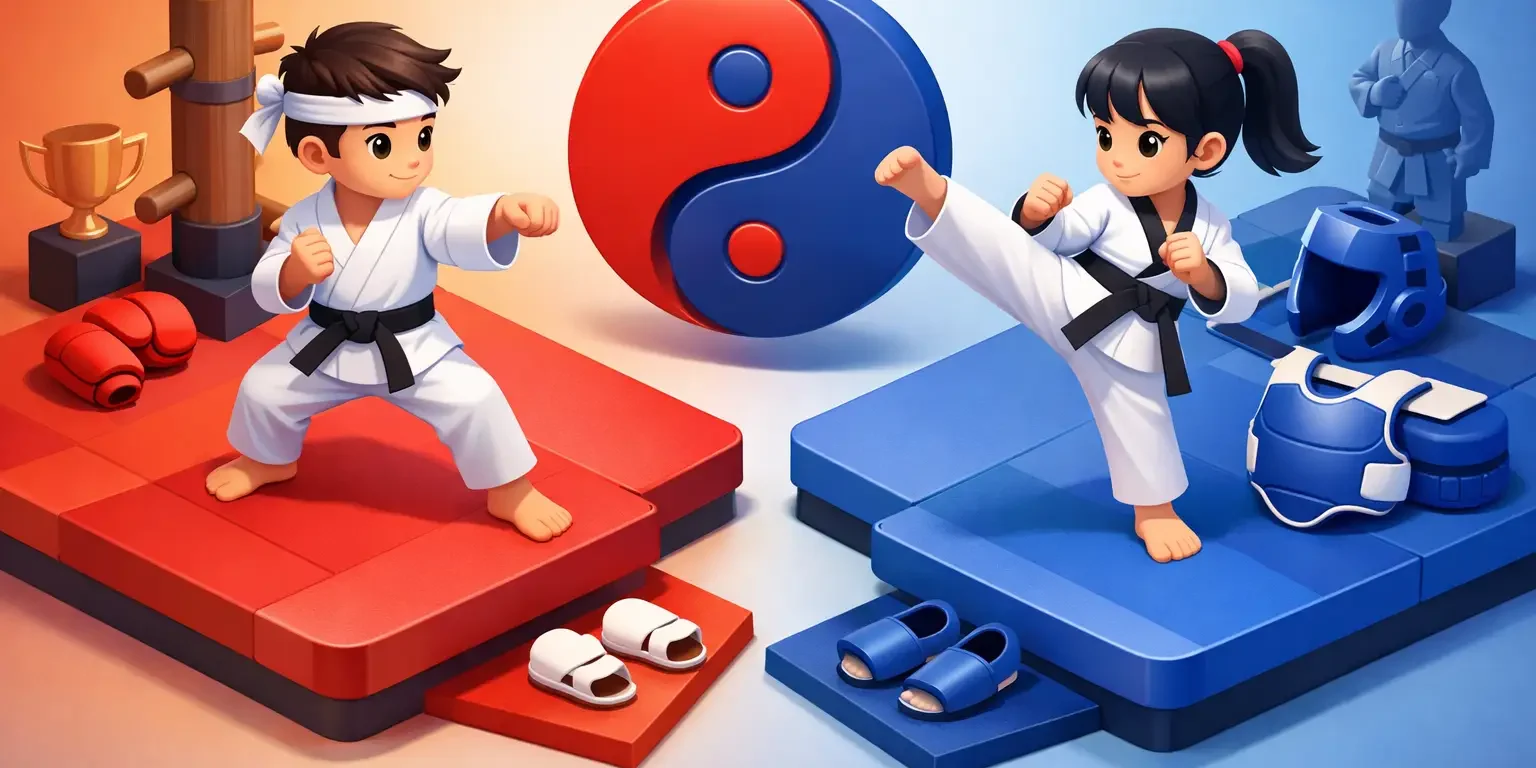
Karate originated in Okinawa and Japan and includes several distinct styles. While each style has its own curriculum, karate is often recognized for its balanced use of hand strikes, blocks, stances, and kicks. Students commonly practice techniques in patterns, work with partners in controlled drills, and learn how body position and focus support each movement.
Taekwondo originated in Korea and is especially known for dynamic kicking techniques. Students learn punches, blocks, stances, and self-defense skills too, but kicking often plays a more visible role in the training. Many children enjoy the energy of learning front kicks, round kicks, side kicks, and eventually more advanced techniques as their coordination improves.
Neither art is automatically better for a child. Both can be challenging, engaging, and age-appropriate when taught by instructors who understand how children learn. The labels matter less than the day-to-day experience: Is the class organized? Does the instructor set clear expectations? Is your child encouraged while still being held accountable?
Karate vs Taekwondo for Children: How Classes Feel
The most noticeable difference for many families is the movement style. Karate classes may place more emphasis on grounded stances and a balanced mix of hands and feet. Taekwondo classes can feel more active through frequent kicking drills, footwork, and flexibility work. A child who loves running, jumping, and practicing athletic kicks may be immediately drawn to taekwondo.
That does not mean karate is less physical or taekwondo is only about kicks. Good beginner programs in either art build the same essential foundation: body awareness, balance, coordination, control, and the ability to follow directions. Children should learn to perform techniques correctly before trying to perform them quickly or powerfully.
Class structure also varies by school. Some programs focus heavily on competition, while others center on personal growth, practical self-defense, and steady belt progression. For most children, especially beginners, a consistent routine is valuable. They benefit from knowing how to line up, listen for instructions, practice a skill, receive feedback, and finish class feeling proud of their effort.
What About Sparring and Self-Defense?
Parents sometimes worry that martial arts will encourage fighting. A well-run program teaches the opposite. Children learn that martial arts skills come with responsibility. They should use respectful words, walk away from conflict when possible, and get help from a trusted adult when a situation feels unsafe.
Sparring, when introduced, should be supervised, controlled, and appropriate for the student’s age and level. It is not a playground fight. It helps students practice distance, timing, composure, and self-control while following rules designed to protect everyone involved. Self-defense training should likewise emphasize awareness, boundaries, and non-violent conflict resolution before physical techniques.
The Benefits Parents Often Notice First
The physical benefits are easy to see. Children develop strength, coordination, flexibility, and healthy habits through regular practice. Yet many parents notice the off-the-mat changes first: a child starts making better eye contact, remembers to use respectful language, or keeps trying after a difficult school assignment.
Martial arts provide frequent opportunities to practice small acts of perseverance. A new form may feel confusing. A kick may not balance correctly the first few times. Earning a new belt requires steady attendance, effort, and improvement. When children work through those moments in a supportive setting, they learn that progress is earned one class at a time.
This is especially helpful for children who need a constructive outlet after school. Martial arts classes offer clear rules without being cold or intimidating. A child can be energetic, shy, new to sports, or still developing social confidence and find a place to grow. The goal is not to turn every student into a champion competitor. It is to help each student become more capable and confident.
How to Choose the Right Martial Art for Your Child
Start with your child’s interests, but do not stop there. A child who says, “I want to learn flying kicks,” may enjoy taekwondo’s kicking focus. Another child may be curious about karate’s hand techniques, forms, and traditional stances. Their initial excitement is useful because it gives them a reason to come through the door.
Then look closely at the program itself. For a 4- to 6-year-old, the best fit is usually an age-specific class that keeps instruction simple, active, and encouraging. Young children need practice with listening, taking turns, following a sequence, and managing big feelings. A class designed for older students may move too quickly or expect more independence than they are ready to show.
For children ages 7 to 12, ask whether the school offers a clear path forward. They are old enough to understand goals, work toward rank advancement, and take greater ownership of their training. They still need instructors who make corrections with patience and who recognize that every child progresses at a different pace.
Visit the School With These Questions in Mind
During an introductory class or observation, pay attention to how instructors speak to students. Are corrections clear and respectful? Do students know what they are expected to do? Is there a healthy mix of structure, movement, and encouragement? A child should leave challenged, not embarrassed or overwhelmed.
It also helps to ask how the school handles safety, sparring, belt testing, and missed classes. Find out whether character education is woven into the curriculum or mentioned only in marketing. Respect, self-discipline, and goal setting should show up in the way the class is actually taught.
Finally, consider the community. Families are more likely to stay with martial arts when they feel known and welcomed. A local school with consistent instructors can give children positive role models over many years, not just one season. That sense of belonging matters when a student hits a plateau, feels nervous before testing, or needs encouragement to keep going.
Why a Structured Taekwondo Program Can Be a Strong Choice
For families who are leaning toward taekwondo, a structured program can combine the athletic appeal of kicking with meaningful life-skill development. At ATA Integrity Martial Arts, students work through age-appropriate training that supports confidence, focus, respect, and personal responsibility alongside martial arts technique.
The ATA approach gives students clear goals through belt progression while instructors help them understand that a belt represents more than a new color. It represents attendance, effort, improved skills, and the character to use those skills responsibly. Children have room to celebrate achievements while learning that growth takes practice.
Taekwondo can be particularly motivating for children who need an activity with visible milestones. They can see a kick become higher, a form become smoother, or a previously difficult skill become familiar. Those wins build momentum, especially when instructors connect effort in class to effort at home and school.
Give Your Child a Chance to Try
The best decision does not have to be permanent on day one. An introductory class gives your child a chance to step onto the mat, meet the instructor, and experience the rhythm of training. It also gives you a clearer view than any video or description can provide.
Look for the moment your child stands a little taller after class, remembers a new word like “focus,” or asks when they can come back. That small spark, supported by patient instruction and a respectful community, can become a journey that strengthens them far beyond the mat.